.svg)
Australian road freight costs could increase 20-30% in a prolonged Middle East conflict
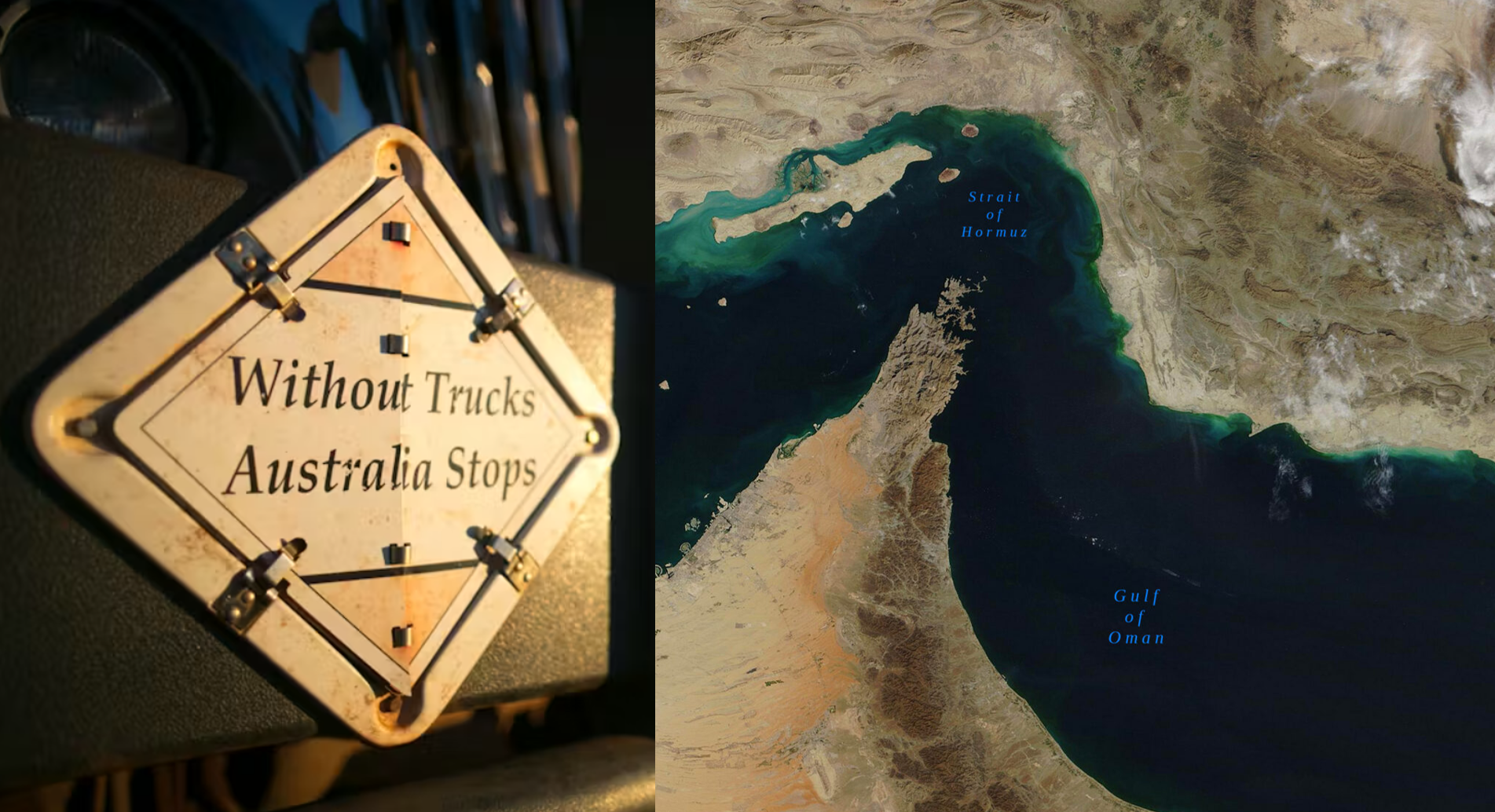
A prolonged conflict in the Middle East could increase Australian road freight costs by 20–30%, triggering a sharp rise in the cost of food and other essential goods and accelerating inflation across the economy.
Escalating energy crisis
On Friday 27 February, Brent crude traded at US$73 per barrel. Just seven days later it had surged 27% to US$93, following Iran’s closure of the Strait of Hormuz and missile and drone attacks that forced multiple oil facilities across Saudi Arabia, Qatar, the UAE, Bahrain, Oman and Kuwait offline.
On Saturday, Qatar’s Energy Minister Saad al-Kaabi warned that oil and gas exporters across the Gulf could halt production within days. Speaking to the Financial Times, he said the escalating conflict in the Middle East — a region central to global energy production and shipping routes — could “bring down the economies of the world.”
Australian domestic supply chains highly exposed
After the United States, Australia is the second most road-freight-dependent nation in the world.
Unlike the US, however, around 90% of Australia’s refined diesel and crude oil is imported, arriving through a limited number of shipping routes, with roughly 30% passing through the Strait of Hormuz.
The vast majority of Australia’s domestic supply chains rely on diesel-powered trucks. This includes the country’s food supply chain, which moves produce from regional farms through processing facilities and distribution centres to the supermarkets where most of Australia’s 26 million people source their food.
Australia consumes roughly 32 billion litres of diesel each year across road transport, mining, rail and marine sectors. Approximately half — around 16 billion litres — is burned by heavy trucks transporting freight on Australian roads.
The link between global oil prices and Australian diesel
In 2016, theAustralian Government’s Bureau of Infrastructure, Transport and Regional Economics (BITRE) analysed fuel price data going back to 1925 to examine the relationship between global oil prices and Australian retail fuel prices. The report concluded that Australian petrol and diesel prices are overwhelmingly determined by global oil prices.
For diesel, the analysis concluded that 99.6% of the variation in Australian diesel prices since 1970 can be explained by changes in global oil prices. Petrol prices showed a similarly strong correlation of 97% dating back to 1925.
This near-perfect relationship allows analysts to forecast Australian diesel price movements with relatively high confidence based on global oil price scenarios.
Diesel price impact on road freight
According to BITRE, heavy articulated trucks represented just 3% of Australia’s commercial vehicle fleet in 2023 yet accounted for 79% of all road freight tonne-kilometres. Most of this freight is carried by single and double articulated trailer combinations.
Diesel typically accounts for 25–35% of the total operating cost of heavy trucking. The remaining costs include driver wages, maintenance and tyres, depreciation and finance, insurance, registration and overheads.
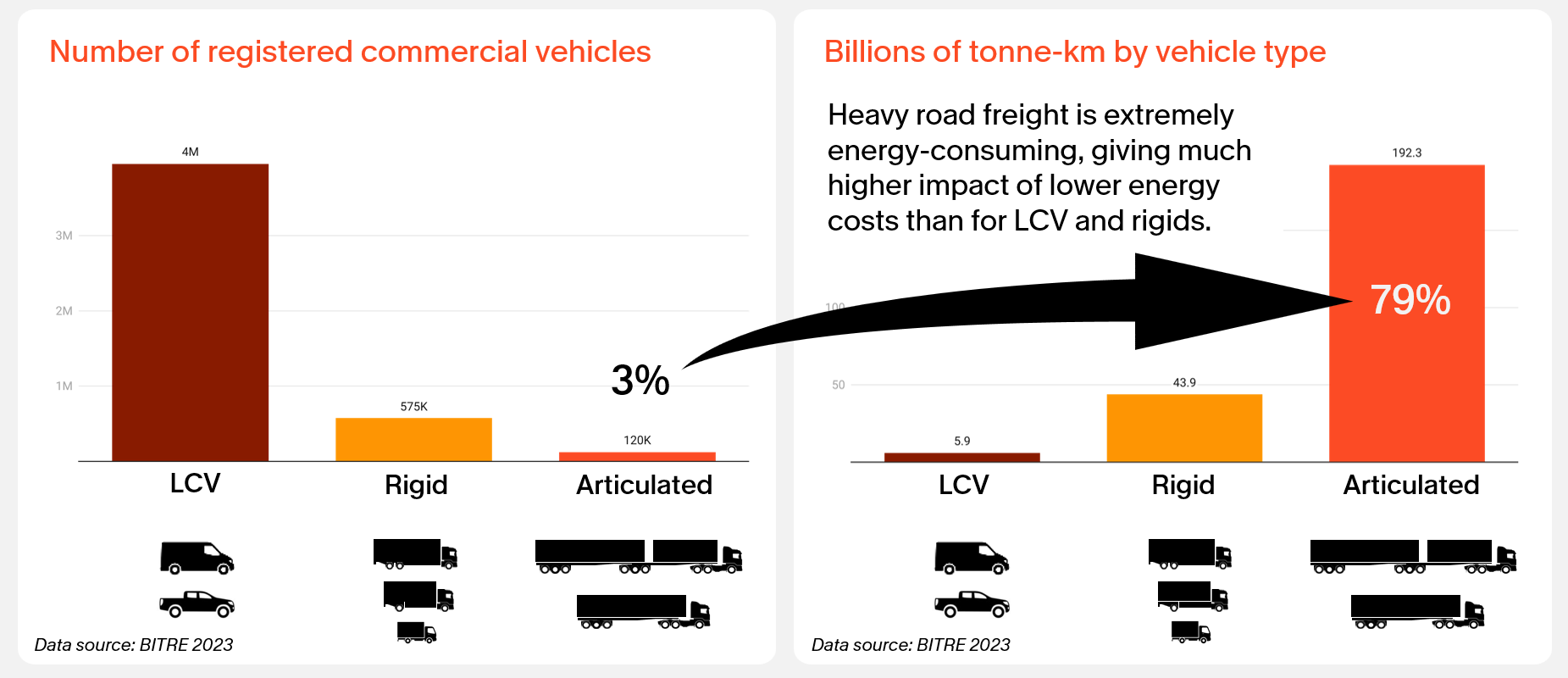
Because fuel represents such a large portion of operating costs, increases in diesel prices flow directly into road freight pricing. Using the established relationship between oil prices and Australian diesel prices, it is possible to estimate the downstream impact on freight costs.
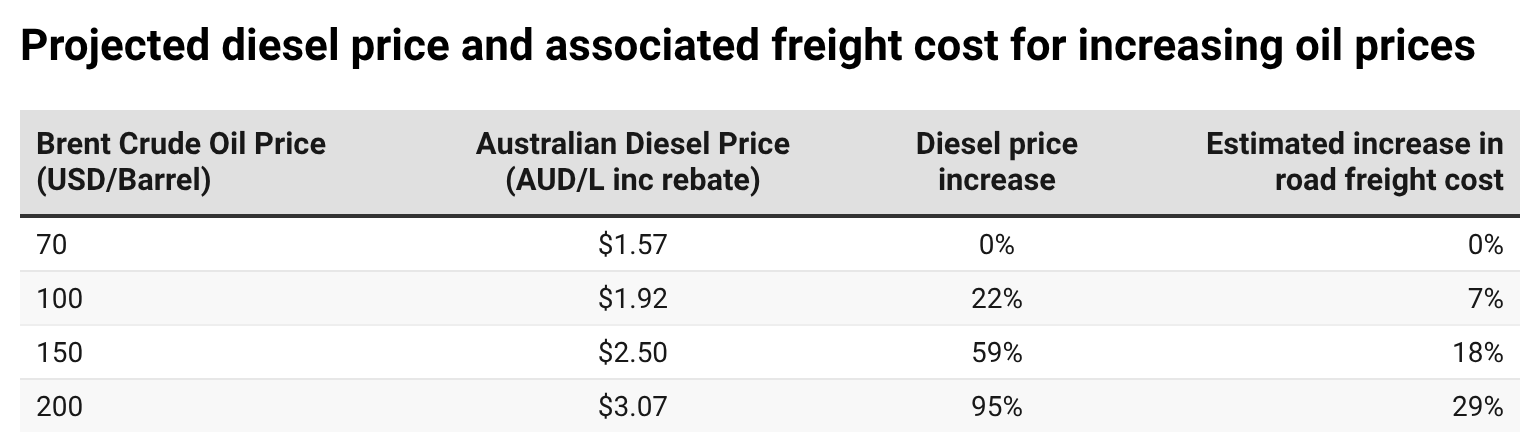
Under a prolonged war scenario, the modelling suggests Australian road freight costs could increase by 20–30%, significantly increasing the cost of food and consumer goods and placing upward pressure on inflation across the economy.
Electric trucks offer a pathway to resilience
New Energy Transport recently conducted Australia’s longest single-charge electric truck delivery, completing a 480 km round trip with a 36-tonne gross combined mass. The demonstration showed that heavy electric trucking is not only viable, but capable of improving productivity while reducing operating costs and strengthening supply-chain resilience.
NET’s business model is designed to match diesel-based road freight pricing.Financial modelling indicates that an integrated system — combining electric trucks, high-speed charging infrastructure and low-cost renewable energy —could reduce road freight costs by more than 20% compared with diesel trucking. If diesel prices rise significantly, those savings could increase to 40–50%.
While electric trucking companies operate within the highly commoditised freight market, their energy costs are largely decoupled from global oil markets. By pairing renewable energy generation with high-power charging infrastructure and electric prime movers, Australia has the opportunity to onshore the production of transport energy and reduce its exposure to volatile global oil supply chains.
In an increasingly unstable geopolitical environment, electric truck fleets and high-capacity charging depots could become critical national infrastructure, capable of moving thousands of tonnes of food and essential goods regardless of disruptions to global oil supply.
If Australia wants to avoid a future where its domestic supply chains remain vulnerable to global energy shocks, it must act now to build sovereign capability through resilient, electrified transport infrastructure.
